
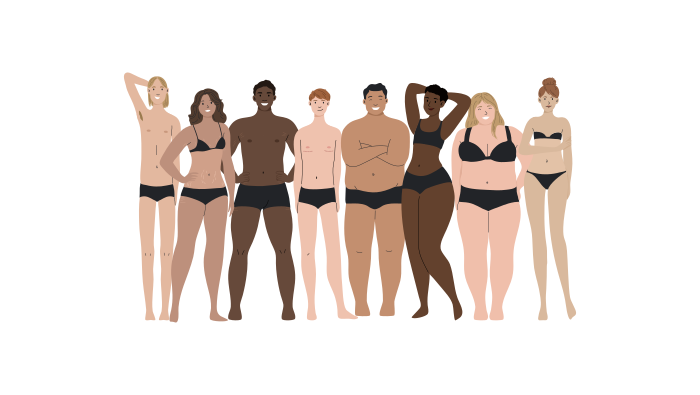
Body image
Overview
Our teaching on body image tackles one of the most persistent pressures in young people's lives — the feeling that their body isn't good enough.
This topic takes in where body image comes from: the influence of social media, advertising, peer comparison, and cultural ideals that are narrow, unrealistic, and often digitally altered. It explores the specific pressures on different groups — girls and diet culture, boys and muscle dysmorphia, LGBTQ+ young people and the gap between how they feel and what they see reflected back.
But this isn't just about identifying the problem. It's about building something better. Whether a session focuses on media literacy and the reality behind filtered images, or on self-talk and the relationship young people have with their own reflection, the aim is to replace comparison with something more grounded.
Key learning outcomes
By the end of lessons on this topic, students will:
- Understand how social media, advertising, and peer culture shape body image
- Recognise the difference between realistic and digitally altered or curated images
- Explore how body dissatisfaction connects to mental health, eating disorders, and self-harm
- Develop critical thinking skills to challenge unrealistic beauty and body standards
- Build strategies for positive self-talk and body respect
- Understand that body image pressures affect all genders, though in different ways
- Know where to access support if body image concerns are affecting their wellbeing
Why teaching about body image matters
Body dissatisfaction is starting earlier than ever. Primary-age children are expressing unhappiness with how they look. By secondary school, the majority of young people — across all genders — report feeling negatively about their bodies.
This isn't vanity. It's a mental health issue. Poor body image is linked to depression, anxiety, eating disorders, and social withdrawal. When schools address body image directly — not as an add-on, but as a core part of wellbeing education — they equip young people with the tools to push back against a culture that profits from making them feel inadequate.
Curriculum alignment
This topic addresses 6 requirements from the DfE statutory RSE guidance and 10 learning outcomes from the PSHE Association Programme of Study , across KS1, KS2, KS3, KS4, KS5.
View all curriculum references
DfE RSE Statutory Guidance 2026
- "How advertising and information is targeted at them and how to be a discerning consumer of information online, understanding the prevalence of misinformation and disinformation online" Secondary Health: Wellbeing online, 5 · KS3, KS4
- "How stereotypes, in particular stereotypes based on sex, gender reassignment, race, religion, sexual orientation or disability, can cause damage (e.g. how they might normalise non-consensual behaviour or encourage prejudice)" Secondary RSE: Respectful relationships, 9 · KS3, KS4
- "The characteristics of social media, including that some accounts are fake, may post things which are not real or have been created with AI, and that users may present highly exaggerated or idealised profiles of themselves" Secondary RSE: Online safety and awareness, 3 · KS3, KS4
- "The importance of self-esteem, independence and having a positive relationship with oneself, and how these characteristics support healthy relationships with others" Secondary RSE: Respectful relationships, 3 · KS3, KS4
- "The importance of self-respect and how this links to their own happiness" Relationships Education: Respectful kind relationships, 8 · KS1, KS2
- "The similarities and differences between the online world and the physical world, including the impact of unhealthy or obsessive comparison with others online and how people may curate a specific image of their life online" Secondary Health: Wellbeing online, 2 · KS3, KS4
PSHE Association Programme of Study 2020
- "About personal identity; what contributes to who we are (e.g. ethnicity, family, gender, faith, culture, hobbies, likes/dislikes)" KS1-2 Core Theme 1: Health and Wellbeing, H25 · KS1, KS2
- "How different media portray idealised and artificial body shapes; how this influences body satisfaction and body image and how to critically appraise what they see and manage feelings about this" KS4 Core Theme 1: Health and Wellbeing, H3 · KS4
- "How self-confidence, self-esteem, and mental health are affected positively and negatively by internal and external influences and ways of managing this" KS4 Core Theme 1: Health and Wellbeing, H2 · KS4
- "How we are all unique; that recognising and demonstrating personal strengths build self-confidence, self-esteem and good health and wellbeing" KS3 Core Theme 1: Health and Wellbeing, H1 · KS3
- "Simple strategies to help build resilience to negative opinions, judgements and comments" KS3 Core Theme 1: Health and Wellbeing, H4 · KS3
- "That the portrayal of sex in the media and social media (including pornography) can affect people's expectations of relationships and sex" KS3 Core Theme 2: Relationships, R8 · KS3
- "The impact that media and social media can have on how people think about themselves and express themselves, including regarding body image, physical and mental health" KS3 Core Theme 1: Health and Wellbeing, H3 · KS3
- "To evaluate expectations about gender roles, behaviour and intimacy within romantic relationships" KS3 Core Theme 2: Relationships, R11 · KS3
- "To recognise how idealised images of bodies and pressure to conform can adversely affect body image and self-esteem; strategies to manage this pressure" KS5 Core Theme 1: Health and Wellbeing, H2 · KS5
- "To recognise what makes them special" KS1 Core Theme 1: Health and Wellbeing, H21 · KS1, KS2
Explore ready-made lessons on Body image
Browse expert-written RSE lessons in the Tailor library, ready to use with your students.
Questions young people ask about Body image
-
 Sexual Health
Are you a slag if you get an STD?
Read the answer -
 Anatomy
Can your penis snap during intercourse?
Read the answer -
 Anatomy
Does DNA determine your penis size?
Read the answer -
 Sex
SexDoes it hurt when women and men have sex for the first time?
Read the answer -
 Sex
SexDoes the 1st time always hurt?
Read the answer -
 Anatomy
Does wanking help with penis growth?
Read the answer
Related topics
Bring Body image into your school
Expert-led RSE sessions delivered directly to your students, or training for your staff to deliver with confidence.
RSE training